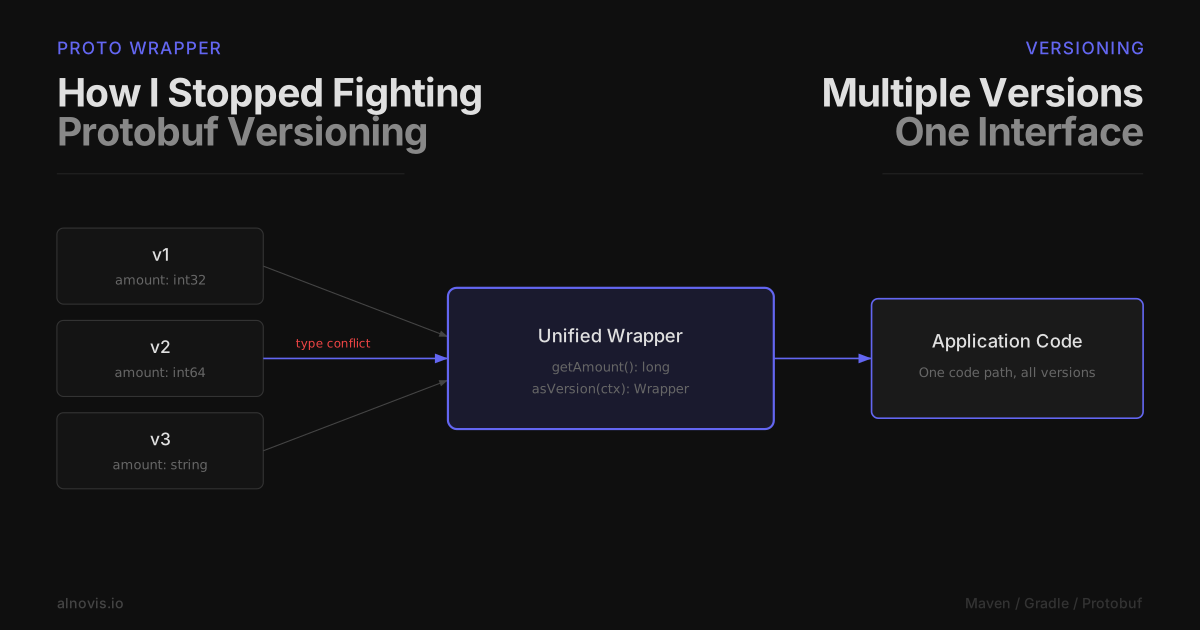
If you've ever worked on a system that processes protobuf messages from multiple protocol versions, you know the pain. You add a new field, change a type from int32 to enum, and suddenly your codebase is littered with if (version == 1) ... else if (version == 2) blocks.
I built Proto Wrapper Plugin to solve this problem once and for all.
The Pain Point
Here's a typical scenario. You have a payment processing system. Version 1 of your protocol uses an integer for payment type:
// v1/payment.proto
message Payment {
  int32 payment_type = 1;  // 1=cash, 2=card, 3=transfer
}
Then someone decides (rightfully so) that enums are better:
// v2/payment.proto
message Payment {
  PaymentType payment_type = 1;
}

enum PaymentType {
  CASH = 1;
  CARD = 2;
  TRANSFER = 3;
}
Now your code looks like this:
// This is everywhere in your codebase
if (protocolVersion == 1) {
    int type = paymentV1.getPaymentType();
    processPayment(type);
} else if (protocolVersion == 2) {
    PaymentType type = paymentV2.getPaymentType();
    processPayment(type.getNumber());
}
Multiply this by dozens of messages, and you have a maintenance nightmare.
The Solution: One Interface to Rule Them All
Proto Wrapper generates a unified Java API that works across all your protocol versions:
// Single code path. Works with v1, v2, v3... whatever.
Payment payment = versionContext.wrapPayment(anyProto);
int type = payment.getPaymentType();  // Always returns int
PaymentType typeEnum = payment.getPaymentTypeEnum();  // Returns enum when available

byte[] bytes = payment.toBytes();  // Serializes back to original version
The plugin analyzes your proto schemas, detects conflicts, and generates appropriate accessors. You write version-agnostic code, and the generated wrappers handle the details.
Getting Started
Add the plugin to your Maven build:
<plugin>
    <groupId>io.alnovis</groupId>
    <artifactId>proto-wrapper-maven-plugin</artifactId>
    <version>2.2.0</version>
    <configuration>
        <basePackage>com.example.model</basePackage>
        <protoRoot>${basedir}/proto</protoRoot>
        <versions>
            <version><protoDir>v1</protoDir></version>
            <version><protoDir>v2</protoDir></version>
        </versions>
    </configuration>
    <executions>
        <execution><goals><goal>generate</goal></goals></execution>
    </executions>
</plugin>
Or if you prefer Gradle:
plugins {
    id("io.alnovis.proto-wrapper") version "2.2.0"
}

protoWrapper {
    basePackage.set("com.example.model")
    protoRoot.set(file("proto"))
    versions {
        version("v1")
        version("v2")
    }
}
Run mvn generate-sources or ./gradlew generateProtoWrapper, and you get a clean API.
What Conflicts Can It Handle?
Over time, I've added support for pretty much every type conflict I've encountered in production:
INT_ENUM — The most common one. Field starts as int32, becomes enum. You get both getField() (returns int) and getFieldEnum() (returns enum).
ENUM_ENUM — Two different enums across versions. Unified as int with enum conversion methods.
WIDENING — int32 grows to int64. The wrapper uses long everywhere, with runtime validation for versions that need the narrower type.
FLOAT_DOUBLE — Precision change from float to double. Unified as double.
SIGNED_UNSIGNED — int32 vs uint32, sint32 vs int32. Unified as long with proper range validation.
PRIMITIVE_MESSAGE — A simple int64 total becomes Money total with amount and currency. You get getTotal() for primitive versions and getTotalMessage() for message versions.
STRING_BYTES — Someone decides string should be bytes. Dual accessors handle the conversion.
REPEATED_SINGLE — Field changes from singular to repeated or vice versa. Returns List in all cases.
FIELD_RENUMBER — Sometimes field numbers change between versions (legacy systems, don't ask). You can explicitly map them:
<fieldMappings>
    <fieldMapping>
        <message>Order</message>
        <fieldName>parent_ref</fieldName>
        <versionNumbers>
            <v1>3</v1>
            <v2>5</v2>
        </versionNumbers>
    </fieldMapping>
</fieldMappings>
The diff tool can even detect suspected renumbering and suggest the configuration.
Batteries Included
A few things that make life easier:
No protoc installation required. The plugin downloads the right protoc binary for your platform automatically. Just works.
Incremental builds. Changed one proto file? Only affected wrappers regenerate. Saves 50%+ build time on large projects.
Well-known types conversion. google.protobuf.Timestamp becomes java.time.Instant. Duration becomes java.time.Duration. No more manual conversions.
Builder pattern. Full support for creating and modifying messages:
Payment payment = Payment.newBuilder(ctx)
    .setPaymentType(PaymentType.CARD)
    .setAmount(Money.newBuilder(ctx)
        .setValue(1000)
        .setCurrency("USD")
        .build())
    .build();
Spring Boot Starter. For Spring Boot 3+ projects, there's an auto-configuration that handles version context per HTTP request.
Schema Diff Tool
Before deploying a new protocol version, you probably want to know what changed. The built-in diff tool helps:
mvn proto-wrapper:diff -Dv1=proto/v1 -Dv2=proto/v2
It shows added/removed fields, type changes, and flags breaking changes. You can integrate it into CI to catch compatibility issues before they hit production:
mvn proto-wrapper:diff -Dv1=proto/production -Dv2=proto/development -DfailOnBreaking=true
Output formats include text, JSON, and Markdown for reports.
Version Constants
No more magic strings. The plugin generates a ProtocolVersions class:
// Compile-time constants
String version = ProtocolVersions.V1;

// Runtime validation
if (ProtocolVersions.isSupported(versionId)) {
    VersionContext ctx = VersionContext.forVersionId(versionId);
}

// Fail fast on unknown versions
ProtocolVersions.requireSupported(versionId);
The Generated Code
Here's what the structure looks like:
com/example/model/
├── api/
│   ├── Payment.java           # Interface
│   ├── PaymentType.java       # Unified enum
│   ├── VersionContext.java    # Factory
│   ├── ProtocolVersions.java  # Constants
│   └── impl/
│       └── AbstractPayment.java
├── v1/
│   ├── PaymentV1.java
│   └── VersionContextV1.java
└── v2/
    ├── PaymentV2.java
    └── VersionContextV2.java
The generated code is plain Java. No runtime dependencies beyond protobuf itself. You can read it, debug it, understand it.
Links
The plugin is open source (Apache 2.0) and actively maintained. If you're dealing with protobuf versioning headaches, give it a try.